ABOUT US | 562-449-0139

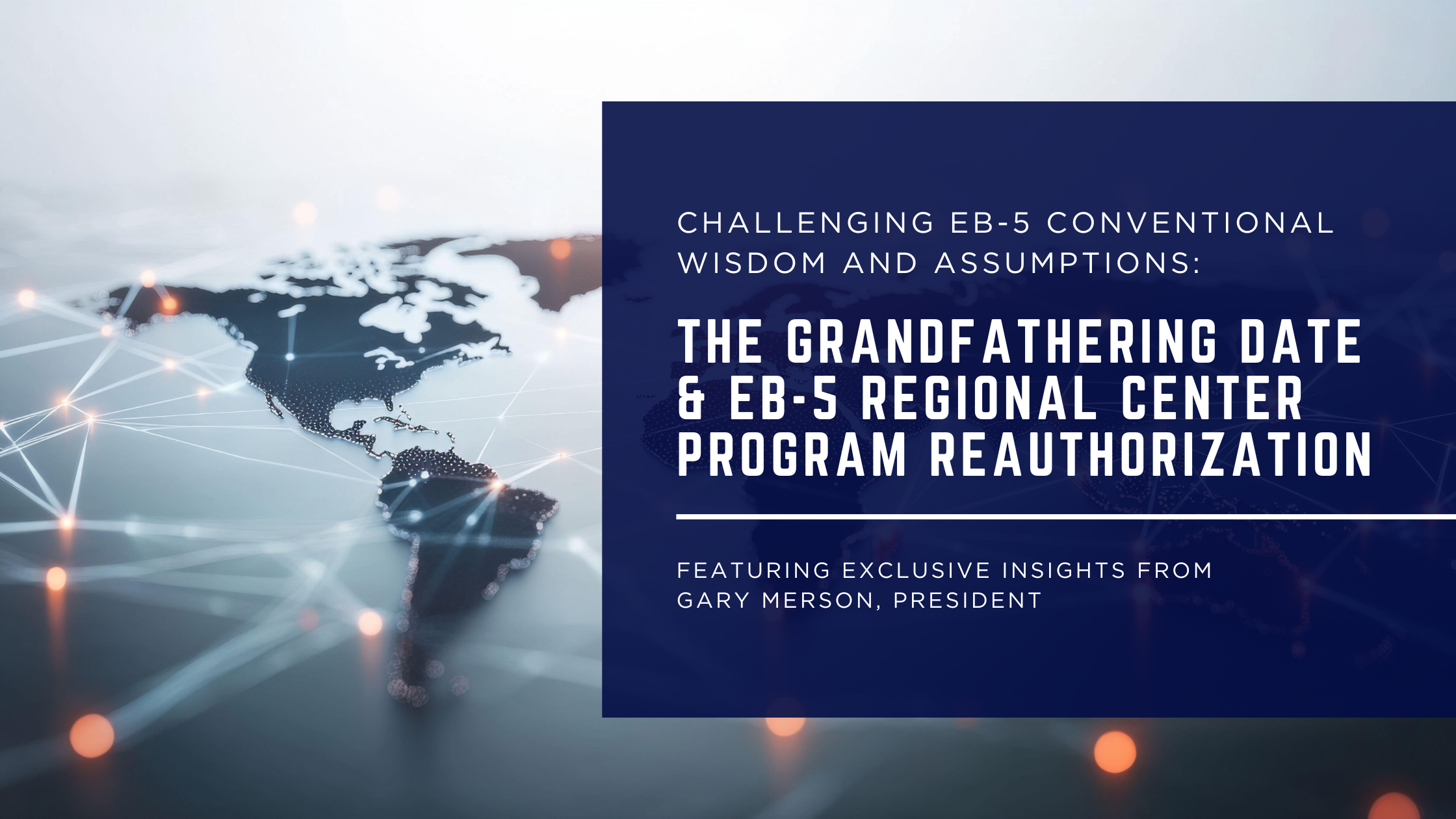
Many EB-5 stakeholders believe that after the EB-5 Reform and Integrity Act (RIA) grandfathering provision expires on September 30, 2026, the EB-5 market will fall off a cliff.
This prevailing view among potential EB-5 investors, broker-dealers, sales agents, and even regional centers, may be overstated and based on faulty assumptions.
Legal Authorities and Background
The RIA includes a grandfathering provision under which investors who file petitions on or before September 30, 2026 are protected from a future lapse in or expiration of the EB-5 Regional Center program.
The Regional Center program is set to sunset on September 30, 2027, absent congressional action. Pursuant to the grandfathering provision, Form I-526E petitions filed prior to September 30, 2026, will continue to be adjudicated, visas will be issued, and associated Form I-829 petitions will also be adjudicated even if the program lapses or expires.
The grandfathering deadline already appears to be creating a rush to file as investors seek to take advantage of this protection afforded by the RIA.
A Look Back at Program Lapse
The lapse in the Regional Center program from June 30, 2021, to March 15, 2022, is seared in the memory of many EB-5 stakeholders. During the lapse, USCIS halted adjudications and indicated that eventually it would have to deny pending investor petitions. The lapse caused immense stress for petitioners who wondered if they would ever be able to obtain permanent residence through an EB-5 investment, as they had been promised.
Understanding the impact of the lapse and the risk of one in the future, the American Immigrant Investors Alliance (AIIA), an organization dedicated to informing, educating, and advocating on behalf of all EB-5 investors, lobbied Congress for the grandfathering provision.
Now, for the first time in the history of the EB-5 program, there is a grandfathering provision to protect investors from program expiration.
The Current State of Affairs
Many broker-dealers and immigration lawyers believe that new investment in the program will essentially grind to a halt after September 30, 2026. Some believe that it would be dubious to advise a potential investor to commit funds after the grandfathering deadline has passed.
All of this presupposes, however, that the program will not be reauthorized or that there will be a lengthy lapse, necessitating the grandfathering protection. And based on the 2021 lapse, the concern is understandable.
In fact, the EB-5 program will continue to exist even after the passing of the grandfathering date and is likely to be reauthorized.
The EB-5 program is in a fundamentally different place from 2021 and prior to enactment of the RIA. The Regional Center program lapsed precisely because of opposition to reforms that prevented Congress from passing legislation for years.
It was only because of the strategically clever move by pro-reform Members of Congress to decouple the EB-5 program from the regular appropriations timeline that the program lapsed.
Previously, the EB-5 program was reauthorized in short-term or one-year increments at the same time Congress passed federal government budget legislation. During these short-term extensions, when there was no grandfathering provision, USCIS continued to adjudicate petitions, and will do so again, assuming the EB-5 Regional Center program is included in the continuing resolution as it has been in the past.
In December 2020, when the program was reauthorized for six months, rather than a one-year extension, the pro-reform Members finally had the upper hand. The Regional Center program lapsed, the agency halted adjudications, and pressure built.
Voila: Nine months later, the EB-5 Reform and Integrity Act of 2022 became the law of the land.
Bias and the Prospects for Reauthorization
Recency and experiential biases are cognitive tendencies to overemphasize a recent or experienced event or data. This is precisely what is driving all of the urgency and anxiety around the expiration of the grandfathering provision.
Admittedly, there were also some questionable remarks about the EB-5 program from a senior administration official, but that was many months ago, and they have not been repeated.
In fact, a counsel for one of the key Senators involved in reauthorization has communicated to stakeholders that the program will be reauthorized.
A broad coalition of stakeholders, including IIUSA, the Real Estate Roundtable, and the EB-5 Rural Alliance—organizations that were at odds over reform—have joined forces to advocate for reauthorization and an extension of the grandfathering provision.
There is a broad consensus for reauthorization among Members of Congress on both sides of the aisle and all of the EB-5 players.
There may be policy disagreements, for example on the sustainment period, or some small amendments such as providing for inflation-related increases to the minimum investment more frequently than every 5 years, but there should not be a bitter fight over reforms like we saw prior to enactment of the RIA.
Moreover, the EB-5 Regional Center program reauthorization is back on the appropriations cycle.
If the program is not permanently reauthorized or extended for a multi-year period before the grandfathering or sunset date, it will almost certainly be temporarily extended through a continuing resolution or a one-year spending bill.
This outcome is particularly likely if Congress fails to complete appropriations by the end of the fiscal year, which almost certainly will be the case.
While that would not be an ideal outcome for program stability, it is not a lapse or expiration.
Since the RIA has helped root out fraud and bad actors while driving investments into rural and high unemployment areas, it is hard to imagine Congress turning its back on the EB-5 program.
Conclusion
There are times when group think can take over, but a reasoned analysis dispels conventional wisdom.
Upon review, concerns about the expiration of the grandfathering provision and program reauthorization are overwrought.
There are significant indicators that the program has the support to push the EB-5 program well beyond both the grandfathering and sunset dates.

Gary N. Merson – President
Gary N. Merson is the President of ALC, bringing more than 25 years of experience in U.S. immigration law, policy, and compliance. He most recently served as Chief of Staff at the Office of the Citizenship and Immigration Services Ombudsman within the U.S. Department of Homeland Security and previously contributed to bipartisan EB-5 reform efforts as Chief Counsel for the House Judiciary Committee’s immigration subcommittee. His leadership reflects deep expertise in EB-5 policy and stakeholder engagement.
About American Lending Center:
American Lending Center (ALC) is a private, non-bank lender committed to advancing US economic growth and job creation. Headquartered in Irvine, California, ALC operates 14 USCIS-designated regional centers spanning the continental United States and Hawaii. Since 2009, ALC has deployed more than $2.3 billion in financing, supporting thousands of businesses nationwide and contributing to the creation and retention of over 140,000 jobs. ALC is committed to Immigrant First Investing.
Follow American Lending Center on LinkedIn, Facebook, Twitter, and YouTube.